
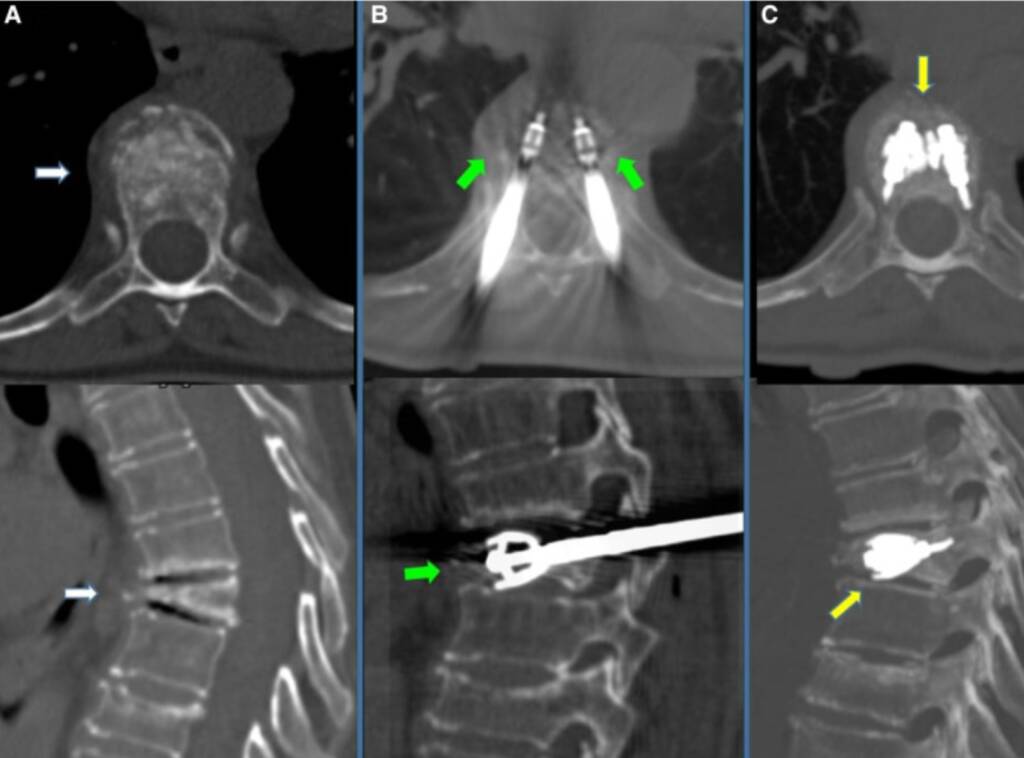
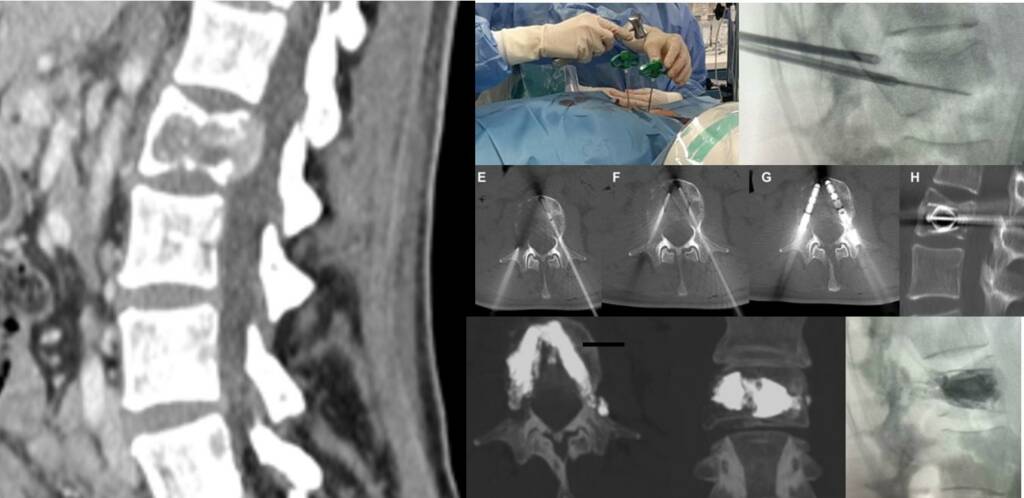
Vertebral implants are minimally invasive devices used to restore vertebral body integrity, improve stability, and in selected cases achieve partial height restoration.
Vertebral implants are minimally invasive devices used to restore vertebral body integrity, improve stability, and in selected cases achieve partial height restoration.
Unlike standard cement techniques, implants (such as expandable systems) provide internal structural support, allowing a more controlled reconstruction of the vertebral body before cement augmentation.
Vertebral compression fractures with significant collapse
Pathological fractures due to metastases or myeloma
Failure or suboptimal response to vertebroplasty / kyphoplasty
In oncologic patients, vertebral implants are often used in combination with cementoplasty and tumor ablation to:
Reinforce structurally compromised vertebrae
Improve biomechanical stability
They are particularly useful in more advanced or structurally complex lesions.
Performed under conscious sedation or general anesthesia, the procedure includes:
Percutaneous transpedicular access
Implant positioning and expansion within the vertebral body
Hospital stay is typically short (around 24 hours).
Improved vertebral stability
Controlled reconstruction of vertebral anatomy
Reduced risk of cement leakage